'%20fill='%231C48DD'/%3e%3crect%20width='26.6139'%20height='7.01829'%20rx='3.50914'%20transform='matrix(-0.499958%20-0.866049%20-0.866001%200.500041%2037.7142%2021.771)'%20fill='%23FFCA29'/%3e%3cpath%20d='M13.4697%200C15.4076%20-8.4718e-08%2016.9794%201.57091%2016.9795%203.50879V20.4912C16.9794%2022.4291%2015.4076%2024%2013.4697%2024C11.532%2023.9998%209.96108%2022.4289%209.96094%2020.4912V7.01855H3.50977C1.57167%207.01855%200.00017846%205.44782%200%203.50977C-1.69425e-07%201.57156%201.57156%201.69462e-07%203.50977%200H13.4697Z'%20fill='%231C48DD'/%3e%3crect%20width='7.01887'%20height='7.01809'%20rx='3.50905'%20transform='matrix(-4.37066e-08%20-1%20-1%204.37162e-08%2054.5601%207.01886)'%20fill='%231C48DD'/%3e%3c/svg%3e)


A well-designed business website today is no longer just about aesthetics. It’s about building a sales machine that Google loves. Because if customers can’t find you on search engines, even the most beautiful design becomes meaningless.
This article breaks down the essential strategies for building a website that succeeds on search engines from technical structure to content that AI systems are more likely to recommend.
Website Design and Its Impact on SEO
SEO and website design are interconnected elements that must be developed in tandem. Google prioritizes User Experience (UX) as a primary ranking factor; therefore, metrics such as user engagement time, bounce rates, and loading performance serve as direct indicators that influence your search rankings. A high-quality design creates a significant first impression that establishes organizational credibility. Conversely, a slow-responding website structure directly triggers negative signals within search engine algorithms, hindering your visibility.
At TumWebSME we focus on designs that reflect professional business standards while implementing technical structures tailored to current user behaviors. Our goal is to build a solid foundation for sustainable long-term growth.
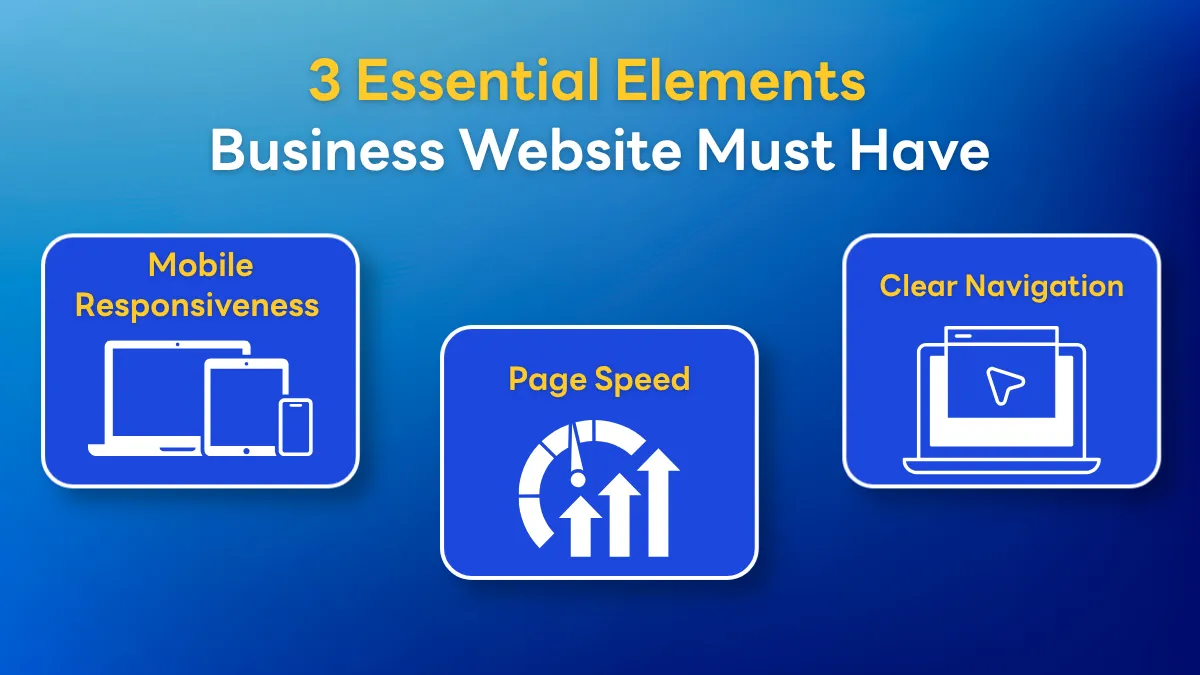
3 Essential Elements Every Business Website Must Have
Regardless of your industry or budget, certain elements are non-negotiable. They directly impact both user experience and search rankings.
Mobile Responsiveness Most users browse on mobile devices. If your site looks great on desktop but breaks on mobile, it’s not finished. Google uses mobile-first indexing, meaning it evaluates the mobile version first.
Clear Navigation Confusing menus increase bounce rates. When users can’t find what they need quickly, they leave and that signals to Google that your site isn’t helpful.
Page Speed Websites that load slower than 3 seconds lose a large portion of users before they even see the content. Google uses Core Web Vitals as ranking signals, so performance must be considered from the design stage not fixed later.
Summary: If your website looks good but is hard to use or slow, it won’t sustainably rank on Google. Rankings are based on real user behavior. What is a Backlink? Guide to Ranking on Google's First Page
Website Structure That Google Prefers
A well-designed business website must have a clear URL structure and page hierarchy so both users and Googlebot can understand it instantly. Best practices include using short, readable URLs (e.g., /services/web-design), avoiding URLs with unnecessary numbers or long query strings, and organizing pages in a logical hierarchy (Home → Services → Blog → Contact). Additionally, every website should have an XML Sitemap to help Google discover and access all pages efficiently.
What is a Sitemap and Why Is It Important?
A sitemap tells Google what pages exist on your website, where they are located, and when they were last updated. Think of it as a map provided to Googlebot, allowing it to crawl your website completely without missing any pages especially those that don’t have internal links pointing to them.
Using Keywords Correctly
When building or developing a new website, proper keyword placement is one of the most critical steps, as it directly impacts search rankings. Key areas where keywords should be placed include. ,The Title Tag (within the first 60 characters), The H1 Heading (the main heading of each page), The first 100 words of the content, Alt Text for all images, The Meta Description (no more than 155 characters)
Important: Avoid keyword stuffing. Overusing keywords can be seen as spam and harm your rankings. The ideal keyword density is around 1–2% of your content.
Core Web Vitals and SEO Rankings
Since 2021, Google has officially included Core Web Vitals as ranking factors. In 2026, they are even more critical. The three key metrics are:
LCP (Largest Contentful Paint): Measures how quickly the main content loads. Ideal: under 2.5 seconds Over 4 seconds: poor performance
INP (Interaction to Next Paint): Measures responsiveness how quickly your site reacts to user interactions. Target: under 200 milliseconds
CLS (Cumulative Layout Shift): Measures visual stability how much elements move during loading. Target: below 0.1 A high-performing website must pass all three.
High-Quality Content Is the Core of SEO
No matter how advanced your SEO techniques are, if the content on your company website lacks quality, your rankings will not be sustainable. Google is placing increasing importance on E-E-A-T (Experience, Expertise, Authoritativeness, Trustworthiness). To create content that Google loves, you should write articles of at least 1,000 words that provide comprehensive answers to user questions and update old content every 6 months. Additionally, include unique insights that cannot be found elsewhere, such as Case Studies or real statistics. Divide the content with H2/H3 headings to make it easy to scan, and use images or infographics to increase engagement.
On-Page SEO Essentials for Every Page
Every page on your business website should undergo basic On-Page SEO setup before publishing, whether it is a service page, a landing page, or a blog post. The essential configurations for every page include a Title Tag not exceeding 60 characters, a Meta Description of 120–155 characters including keywords, Schema Markup (JSON-LD), and a Canonical Tag to prevent duplicate content. Additionally, you should implement Open Graph Tags for social media and ensure a Responsive Design that supports mobile-first indexing.
Recommended Tool: Google Search Console can directly help you monitor rankings, identify errors, and check the Core Web Vitals of your business website.
Try using these 7 points to check if your business website meets Google’s standards in 2026, because improving today is an opportunity to create sustainable sales in the future.
FAQ: Technical Questions on Business Website Development
Q1: How much does design impact SEO?
A: Design has a direct impact through Core Web Vitals and User Experience (UX). Organizing the content hierarchy, using correct Heading Tags within the design layout, and maintaining a balance between aesthetics and loading speed (Performance) are the keys to helping Google rank your website better.
Q2: Why do websites with heavy animations perform poorly in SEO, and how can this be fixed?
A: Google dislikes animations that are resource-heavy and slow down responsiveness. This issue can be resolved by using Lottie Files or CSS Animations instead of heavy video files or GIFs. This approach ensures smooth and fluid movement while keeping your Performance Score in the green zone.
Q3: Does a Mobile-First design make the desktop version look too simple?
A: On the contrary, Mobile-First is about optimizing the content hierarchy. When expanded to a desktop view, we use Responsive Expansion techniques to add features and utilize white space, making the design look clean and premium while ensuring excellent functionality across all devices.
Q4: What layout should be used for Content Marketing or Blogs?
A: Designers should prioritize readability by focusing on line height, font sizes that are easy to read on any device, and sufficient white space to reduce bounce rates. A website with great content but a difficult-to-read design will see its SEO ranking drop because users spend too little time on the page.
Q5: Is a blog necessary for ranking if a website doesn't already have one?
A: It is not mandatory, but highly recommended. A blog is the easiest way to increase the number of high-quality pages, target new keywords, and attract visitors through content that answers customer questions. Company websites with a good blog typically see significantly higher organic search traffic than those without.
Q6: Does using a lot of white space in a Minimalist style affect SEO?
A: It affects it positively! Google prioritizes readability. Proper white space reduces eye strain and decreases the bounce rate because users can find the information they need more easily. A minimalist design with correctly placed Heading structures is the perfect combination for modern websites.
Conclusion: SEO is Not Just Technical, It is About Creating a Truly Great Website
After reading this far, you can see that everything Google evaluates eventually circles back to one question: Does this website truly meet the user's needs? A website that loads fast, is mobile-friendly, contains complete and regularly updated content, is secure, and is referenced by other sources is the kind of site Google wants to present to searchers not a site stuffed with keywords or shortcut hacks.
Designing a business website to rank on the first page of Google is not about tricking the algorithm, but about making a business website good enough for the algorithm to choose it naturally. Do it correctly and consistently, and sustainable results will follow. Let TumWebSME be the partner that takes care of your business website’s growth. We believe a good website must make a business grow, which is why our team designs specialized systems tailored to each industry using modern technology that is fast-loading and built with a structure that fully supports SEO and AI Search.
Follow TumWebSME
Stay updated with insights on website development and digital marketing at:
Facebook: TumWebSME รับทำเว็บไซต์ธุรกิจ
Instagram: @tumwebsme
TikTok: @tumwebsme
YouTube: TumWebSME
Contact Us
For inquiries and service information, feel free to reach out:
Phone: 088-983-9386 (Khun Ploy)
Phone: 099-856-3198 (Khun Saennan)


 @tumwebsme

