'%20fill='%231C48DD'/%3e%3crect%20width='26.6139'%20height='7.01829'%20rx='3.50914'%20transform='matrix(-0.499958%20-0.866049%20-0.866001%200.500041%2037.7142%2021.771)'%20fill='%23FFCA29'/%3e%3cpath%20d='M13.4697%200C15.4076%20-8.4718e-08%2016.9794%201.57091%2016.9795%203.50879V20.4912C16.9794%2022.4291%2015.4076%2024%2013.4697%2024C11.532%2023.9998%209.96108%2022.4289%209.96094%2020.4912V7.01855H3.50977C1.57167%207.01855%200.00017846%205.44782%200%203.50977C-1.69425e-07%201.57156%201.57156%201.69462e-07%203.50977%200H13.4697Z'%20fill='%231C48DD'/%3e%3crect%20width='7.01887'%20height='7.01809'%20rx='3.50905'%20transform='matrix(-4.37066e-08%20-1%20-1%204.37162e-08%2054.5601%207.01886)'%20fill='%231C48DD'/%3e%3c/svg%3e)


For entrepreneurs or business owners planning to build an online platform, many often find themselves confused between the terms Website and Web Application. From the outside, they look quite similar—both have buttons to click and pages to navigate—making it hard to decide which model best fits your business goals. In the business world, choosing the wrong model right from the start could mean unnecessary budget overruns.
In this article, TumWebSME breaks it down for you in the simplest terms. We’ve stripped away the complex technical jargon so you can clearly see which option offers the best return on investment (ROI) for your business.
What is a Website?
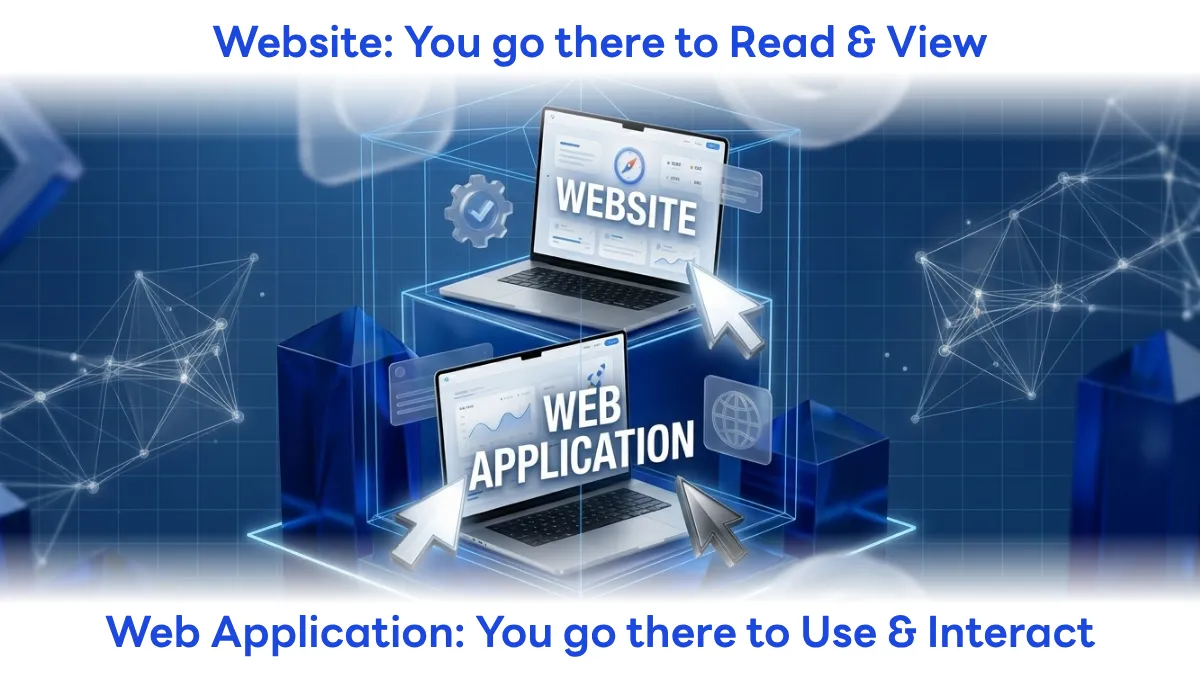
When thinking of a Website, imagine a news portal, a corporate company website (Corporate Website), or an educational blog. These platforms are primarily built to deliver information to users (Read-only). Their defining characteristic is static content, or content that only changes when an administrator updates it from the backend dashboard. General users who visit cannot modify the system or send back complex interactive data, aside from clicking links or filling out a basic contact form.
In terms of access, we are mostly familiar with opening them through web browsers like Google Chrome, Safari, or Microsoft Edge by typing the URL or clicking a direct link. Today, web technology has advanced so much that some standard websites can be configured to place an icon on a mobile home screen for convenience. Therefore, what truly separates a website from a web application isn't just about "opening it on a browser," but rather "the complexity of the system's interactivity."
Business Goal of a Website: Focuses on public relations, building brand credibility, showcasing product or service galleries, and serving as a major spearhead for SEO and online marketing—including AI Search (GEO)—to generate traffic and help new customers find your business easily on the internet.
What is a Web Application?
Moving over to a Web Application, this type of platform is a clear step up from a standard website. The goal isn't just for people to read static information; it is built so users can "actively command, interact, or perform serious transactions."
If you can't picture it, think of platforms like YouTube, an e-commerce checkout system that calculates pricing, a flight booking portal, or even an online photo editor. These operate on the internet just like websites, but behind the scenes, they have mechanisms to calculate, process data, and respond to user inputs in real-time.
Furthermore, a unique feature of modern web applications is that you can "download" them directly as an icon onto your computer or smartphone screen. You don't have to waste time searching or downloading through the App Store or Play Store. Just open the page for the first time via a browser and install it directly from the address bar.
Business Goal of a Web Application: Focuses on using automated systems to reduce manual human labor. It includes a backend management dashboard (Backend Dashboard), membership systems, supports complex transactions, and can dynamically adjust the display on the screen to offer a personalized experience (Personalization) for each individual customer.
Why Choose TumWebSME for Your Web Development?
When building a business website with TumWebSME, you will get a platform that actually works, remains highly secure, and generates real revenue for your business.
1. A Complete Hybrid Solution: Both a Website and Web App in One
We don't just build static information pages; we scale your system into a Hybrid model right from the start. You get a beautiful, fast-loading frontend to attract customers, backed by a powerful application backend to manage your data. Most importantly, we embed deep optimization for SEO and AI Search (GEO) directly into the source code, helping your site rank higher on Google without requiring you to spend extra budget hiring separate SEO agencies.
2. 100% Custom Made: Built and Coded from Scratch, No Ready-Made Templates
Say goodbye to generic templates that look like your competitors or slow performance caused by excessive plugin bloat. Our team designs your user experience and interface (UX/UI) entirely from scratch to match your brand identity. We then use a Custom-Coded approach. The benefits of custom coding include split-second loading speeds and top-tier cybersecurity. Additionally, clean code structures are exactly what Google bots and AI Search algorithms prefer when ranking sites.
3. Premium Consulting: Developed from a True Understanding of Your Business
This is the premium value you receive from us. We believe a great website must stem from a deep understanding of the business model first. The TumWebSME team doesn't just take a brief and build blindly. We dive into studying your customer behavior, open up discussions, and analyze your internal workflows to provide consultations and deliver online solutions that match your growth, solve pain points, and offer the highest worth for your investment.
The Tech Behind the Download: It’s Called PWA
The ability of a web application to be downloaded from the browser onto your home screen comes from a background technology called PWA (Progressive Web App).
To put it simply, a PWA transforms a web platform into a mobile app-like experience. This eliminates the tedious process of searching and downloading through app stores. In the future, whenever you or your clients want to use the system, just tap the icon on the screen. The system launches instantly without needing to open a browser and type the URL repeatedly.
Comparison Table and Technical Indicators
To give you a clearer picture for your business planning, here is a comparison of the key differences that impact development costs and system architecture:
Comparison Topic | Website | Web Application |
Primary Goal | Public relations, providing information, and building brand credibility. | Solving specific problems, automating human tasks, and managing data systems. |
User Behavior | Browsing to read, viewing products/services, and initiating contact. | Logging in to use functions, processing data, or making commercial transactions. |
Data Connectivity | Uses smaller, less complex database structures. | Connects to large databases and frequently integrates external APIs. |
Development | Shorter timeline; focuses on design, layout, and SEO structure. | Longer timeline; focuses on coding logic, workflows, and high security. |
Deep Dive: What Brands Must Know Before Investing
Website (Business Website): Acts like your online storefront and an excellent marketing tool. The core focus is designing for blazing-fast load speeds and a premium look to convert traffic coming from Google Search into sales inquiries.
Web Application (Web App System): Acts like automated backend software. It processes data in real-time and supports complex user permission levels, drastically reducing manual operational steps for your internal team.
If your business requires both a high-ranking storefront to attract leads and a powerful backend management system, choosing a Hybrid Model that seamlessly fuses both systems with TumWebSME is the most cost-effective and scalable solution.
Technical Checklist: Easy Ways to Spot the Difference
If you can't tell them apart from the external design, you can observe how the system behaves using these 3 main technical checkpoints:
Page Loading (Page Load): Standard websites usually reload the entire page (Page Reload) when you navigate to a new section. However, most web applications operate as a Single Page Application (SPA)—when you click a button, the content updates instantly in real-time without any page flickering or reloading.
Data Access Rights (Data Access): If everyone who visits the platform sees the exact same content, it is a website. But if the screen display changes dynamically based on specific user profiles, uploaded photos, or personal user history (Personalization), it is running on a web application system.
URL Structure: Web applications often feature URL structures that clearly state a specific user status or function, such as
/dashboard,/profile/settings, or/checkout. This differs from general websites, which typically use standard structures for content pages or services, like/blogor/services.
Build Your Business Platform Correctly with TumWebSME
Whether your goal is to launch a business website for marketing or develop a web application to manage internal company operations, the keys to success are stability, fast loading speeds, and structures built for search engines and AI Search (GEO). TumWebSME develops platforms using 100% Custom-Coded programming from scratch to ensure your system runs fast, remains secure, and aligns perfectly with your business operations—completely free from heavy pre-made plugins that slow down performance or risk cyber vulnerabilities.
Strategic Selection: A Guide for Business Owners
Where Should Most Businesses Start?
To give you straightforward advice, most businesses "should start with a Website first." The critical first step is finding customers and building brand awareness in the market. A website achieves this faster and requires less initial investment for 3 major reasons:
Establishes Trust on Search Engines: Before making a purchase decision, the first thing customers do is look up a company name on Google Search or ask an AI Search tool. If your business lacks an official primary website, your credibility drops instantly.
Supports Marketing Campaigns to Generate Leads: A website acts like a digital welcoming mat for your traffic from advertisements. Whether you are creating organic content on Facebook or TikTok, or running Google Ads, all traffic lands on your website to read details, view portfolios, and click to contact you to close the sale.
Saves Budget and Delivers Faster Results: A website focuses on clean data presentation and attractive design layouts. It takes less time to develop and costs less than a web application, allowing your business to test the market and generate revenue immediately.
Examples of Business System Growth
Starting with a Business Website: If you run a construction or interior design business, you should start by building a website to showcase your portfolio, display client testimonials, and provide a button to add your Line account for price inquiries (there is no initial need to invest in a complex automated pricing calculation formula).
Scaling into a Web Application: As your business expands and customer inquiries flood in to the point where your team can't manage them manually, you can then scale your platform into a web application. This allows you to add a backend system to manage worker schedules, handle material inventory, or let clients log in to track the real-time progress of their projects.
Which Type of Platform Should Your Business Choose?
Your decision shouldn't be based solely on budget, but rather on the business objectives you want to achieve:
1. Choose a Website when you need: Credibility and Reach
Focuses on delivering information and opening up 24/7 contact channels. Perfect for:
Building a Presence on Search Engines: Aiming for SEO and GEO so your brand ranks first when customers look up information on Google or interact with AI Search engines.
Supporting Marketing Campaigns: Needing clear landing pages (Landing Pages) that load within seconds to convert visitors coming from online ads into actual paying clients.
Supporting Your Sales Team: Showcasing company profiles (Corporate Profiles), product catalogs, and real case studies to build partner confidence before signing a deal.
2. Choose a Web Application when you need: Efficiency-Driving Tools
Focuses on automated systems that handle operations in place of humans in real-time. Perfect for:
Reducing Operational Steps and Time: Requiring software to solve specific issues, such as an automatic quotation calculator or a booking system that instantly updates availability once payment succeeds.
Managing User Permissions: Having a complex user structure that requires a membership system to separate access rights between admins, employees, and clients.
Controlling Data for Business Management: Needing a backend dashboard that compiles and processes internal company data alongside in-depth reporting features to help you make precise strategic decisions.
3. The Hybrid Model: Blending Systems for Optimal Results
In reality, the most successful business platforms do not choose just one model over the other; they integrate both into a single seamless experience:
The Frontend (Website): The public-facing pages focus on beautiful design, fast loading, and proper SEO/GEO structures to pull in traffic from Google and AI Search.
The Backend (Web Application): Once a customer decides to use your service and clicks "Log In" or "Checkout," the system smoothly transfers the user into the web application side to securely process payments, manage credit cards, or handle personal profiles.
Red Flags: Warning Signs That Your Current System Is Failing
If your business already runs an online platform but you are facing any of these situations, it is a clear sign that you need to overhaul your system architecture:
Lagging Performance and Dropping Efficiency: Pages take too long to load because of too many pre-made plugins, or the legacy code structure is not flexible enough to support your growing number of users and data volume.
Repetitive Manual Tasks: Your team still has to manually pull customer data from the website and type it into Excel files because your backend lack automated processing functions, wasting time and increasing human error risks.
No API Integration with External Systems: Your software functions in complete isolation. It cannot connect with external platforms to add convenience, such as shipping providers, bank payment gateways, or automated accounting software.
Why Partner with TumWebSME?
Direct Experience Across Diverse Industries: Our team holds specialized expertise across various enterprise and corporate projects, allowing us to truly understand the deep operational needs and constraints of your specific business sector.
End-to-End Service: We take care of every step, including strategic planning, design, system development, and long-term backend maintenance after deployment. A complete all-in-one service.
Modern Tech, Fast Load Speeds, Easy Rankings: Developed using the latest technology frameworks, our system structures fully support SEO and AI Search (GEO) while ensuring pixel-perfect responsive layouts across all devices.
100% Unique Designs, No Templates (Custom Design & Code): Every system and page is designed fresh to echo your brand's unique identity. The clean code structure ensures top safety, a user-friendly admin dashboard, and full room for future scaling.
Managed by Dedicated Specialists: We work collaboratively under international workflow standards, led by a Business Analyst (BA), UX/UI Designer, Full-stack Developer, and Quality Assurance (QA) engineer to deliver functional, stable software that firmly supports your business.
FAQ: Frequently Asked Questions Regarding Websites and Web Apps
Q1: What is the main difference between a Website and a Web App?
Answer: A Website focuses on providing information, introducing your business, and executing SEO to drive readers in. A Web Application focuses on interactive functionality, featuring user login systems, real-time data processing, and automated tasks that replace manual labor.
Q2: Can I build a standard website first and change it into a web app later?
Answer: Yes, you can. However, you must design your initial system architecture with scalability in mind right from day one. If you use generic ready-made web builders, you might have to rewrite the entire codebase later on to allow for proper security and future API integrations.
Q3: Can a Web Application do SEO to rank on the first page of Google just like a website?
Answer: Yes, it can, but it involves higher technical complexity. Since most web applications run on JavaScript frameworks, they require specialized techniques like Server-Side Rendering (SSR) so Google bots and AI Search crawlers can easily read and index the content for rankings.
Q4: Is an online store (E-commerce) considered a website or a web application?
Answer: It is a Hybrid platform. The storefront showing products and reviews operates as a Website optimized for SEO. Meanwhile, the shopping cart checkout, credit card processing, and backend delivery tracking functions operate as a Web Application.
Q5: Why does developing a web application cost more than a standard website?
Answer: Because web apps involve deep technical complexity. They require 100% custom-coded programming to design secure database layers, protect data privacy, and calculate complex business logic, rather than just focusing on visual layouts or graphic placements.
Conclusion: Drive Your Business Growth Confidently with TumWebSME
Whether your goal is a marketing website or custom internal software to boost organization efficiency, TumWebSME delivers premium 100% Custom-Coded solutions built from the ground up without using templates. Developed by a team of dedicated specialists with over 10 years of experience in the software industry, we cover everything from system analysis, user experience design (UX/UI), programming, to Quality Assurance (QA) testing before launch.
We guarantee a highly secure, split-second loading platform mapped out perfectly for SEO and AI Search (GEO) rules, backed by long-term after-sales support to match your business expansion. Turn your system concepts into a functional, revenue-generating reality that yields the best worth for your investment.
Contact Us for a Free Consultation to Map Out Your Business System
Reach out to chat and consult with our team before making your decision through our online channels:
Facebook: TumWebSME รับทำเว็บไซต์ธุรกิจ
Instagram: @tumwebsme
TikTok: @tumwebsme
YouTube: TumWebSME
Direct Project Inquiries and Services
088-983-9386 (Khun Ploy)
099-856-3198 (Khun Saennan)


 @tumwebsme

