'%20fill='%231C48DD'/%3e%3crect%20width='26.6139'%20height='7.01829'%20rx='3.50914'%20transform='matrix(-0.499958%20-0.866049%20-0.866001%200.500041%2037.7142%2021.771)'%20fill='%23FFCA29'/%3e%3cpath%20d='M13.4697%200C15.4076%20-8.4718e-08%2016.9794%201.57091%2016.9795%203.50879V20.4912C16.9794%2022.4291%2015.4076%2024%2013.4697%2024C11.532%2023.9998%209.96108%2022.4289%209.96094%2020.4912V7.01855H3.50977C1.57167%207.01855%200.00017846%205.44782%200%203.50977C-1.69425e-07%201.57156%201.57156%201.69462e-07%203.50977%200H13.4697Z'%20fill='%231C48DD'/%3e%3crect%20width='7.01887'%20height='7.01809'%20rx='3.50905'%20transform='matrix(-4.37066e-08%20-1%20-1%204.37162e-08%2054.5601%207.01886)'%20fill='%231C48DD'/%3e%3c/svg%3e)


Many SME business owners invest in building a website with the hope that customers will find their business on Google. But when they search for it, they can't find their company name on a single page. This problem happens more often than you think, and the main cause is usually not the content, but whether the website was built according to Google's standards from the very beginning. This article will explain how to build an SME website that passes Google's standards from day one not just making it beautiful, but ensuring it is a website that Google understands, can access quickly, and is ready for AI Search in the future.
What Are Google Standards and Why Are They Important for SMEs?
Google doesn't just "read" website content and rank it based on the length of the article. Instead, it has a multi-dimensional evaluation system that measures a website's quality before deciding whether to show it to people. These standards include loading speed, correct structure, mobile responsiveness, and the quality of the content itself.
Many SME businesses often miss the mark here because their websites are built without considering these standards. The result is a slow-loading website with a confusing structure where Google cannot access important pages, and ultimately, customers cannot find your business. This is why choosing an SME website developer who understands Google's standards is far more important than just choosing someone who "gets it done."
If you want a deeper understanding of website speed metrics, you can read our SME edition of the Core Web Vitals article here.
TumWebSME Builds Websites That Meet Standards From Day One
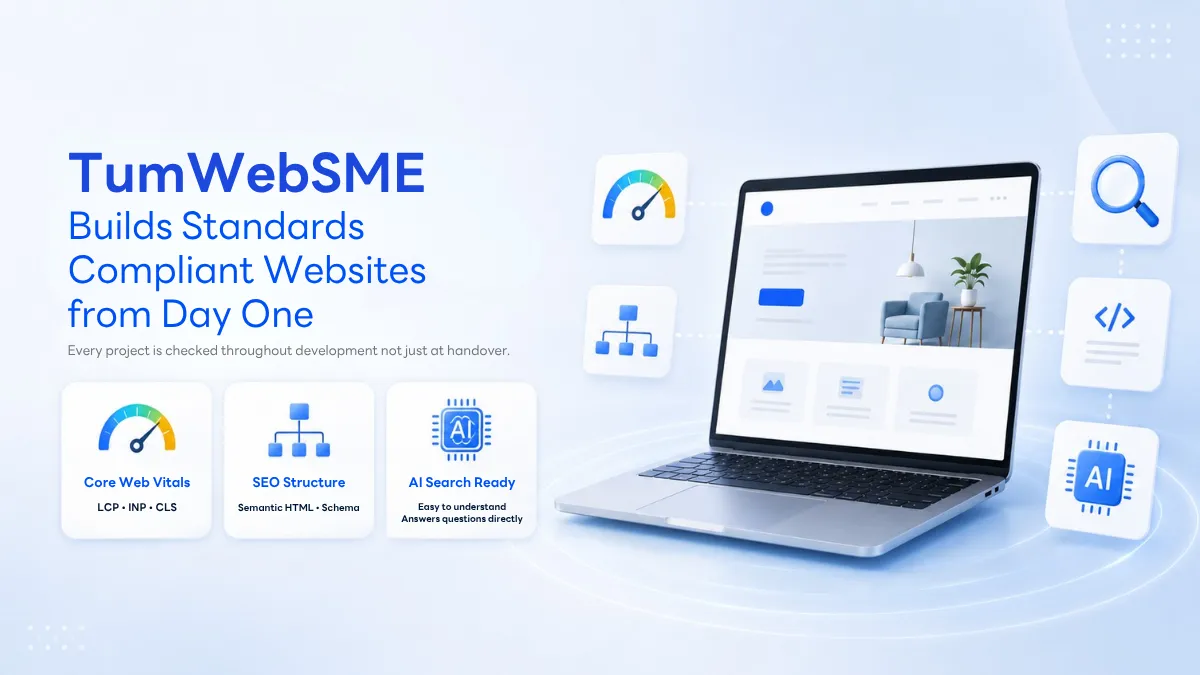
At TumWebSME, we do not view Google's standards as "extra work" to be done later, but rather as a foundation embedded into every step of development from day one. Here is what we check in every project.
Core Web Vitals The 3 Metrics Google Uses to Measure Every Website
Google uses three metrics to measure user experience on a website: LCP (initial page loading speed), INP (responsiveness to clicks), and CLS (visual stability of the web page while loading). Websites built without considering these three factors will often load slowly, have jumping buttons, and cause users to misclick until they get frustrated.
Our team measures these metrics in every phase of development, not just upon final delivery. The result is a website that loads quickly, responds well, and keeps users engaged longer which Google also sees and rewards with good scores accordingly.
SEO Structure That Is Easy for Google to Understand
A good website must use Semantic HTML, which tells Google which part is the heading, which part is the main content, and which part is supplementary information. We create an organized Heading structure (H1-H6), insert Schema Markup to help Google display Rich Snippets, and clearly connect your business's Entities.
This is what separates a custom website built from actual code from a website that simply pulls a template and slaps on a logo. A good internal structure cannot be seen with the naked eye, but Google understands it and gives it a great deal of importance.
AI Search Ready: Preparing for AI Powered Search
Google is no longer the only search channel. AI Search tools like ChatGPT Search, Gemini, and Perplexity are changing the way people find information. What these AIs need is content with a clear structure, factual data, and Entities with verifiable identities.
Therefore, the websites we build for our clients are designed to be easily read and understood by AI, from the use of Structured Data to creating content that answers questions directly. If you are interested in how AI Search will change SEO, you can view our detailed guide here.
From Website Structure to Measurable Results
The difference between a website built just "to get it done" and a website built according to Google's standards is often not obvious on day one. However, it will become clearly apparent after 3-6 months. Websites without standards often find that Google doesn't come to crawl their data, or if it does, the site is stuck on a page that nobody sees.
Websites that meet the standards will see differences in three main areas. First, speed keeps users on the site longer, which Google measures and rewards with better scores. Second, the correct structure helps Google understand what your business sells, allowing it to display results that match search queries more accurately. And third, Schema Markup helps search results feature Rich Snippets that catch the eye and increase click-through rates.
What our clients often tell us after 3 months of use is, "Customers called and said they found us on Google," which is a much more tangible result than view counts or likes. If you want to understand how website structure affects rankings, you can read this article.
A Team That Understands Standards, Not Just "Getting It Done"
Google's standards are constantly changing. What was correct last year might not be enough this year. A team capable of building a website that meets these standards must not merely "know how to write code" but must also keep track of what Google is measuring and continuously adjust their working methods accordingly.
At TumWebSME, our team has experience from large-scale corporate projects such as PTTEP, AIS, and Toyota Connected, which required passing high-level standards. This experience is transferred into our SME website development to achieve those same standards, but tailored to suit the size and budget of small and medium-sized businesses.
Before delivering any project, we have a QA process that checks the website against a Google standards checklist, including speed, structure, security, and mobile display. After delivery, our Care+ service will continuously maintain your website, providing reports via Web Analytics and Google Analytics so you know exactly how your website is performing each month.
Conclusion
Google's standards are not a technical matter that business owners need to understand in deep detail, but they are something that website developers should know and automatically embed into every project. A website that doesn't meet the standards is like a shop opened in a dark alley—customers walk by, but no one sees it.
TumWebSME builds websites that meet Google's standards from day one, with a team experienced in large corporate projects, a QA process that checks every dimension, and the Care+ service that provides continuous maintenance after delivery. We don't just build a website to get it done; we build it so that your business can truly be discovered on Google.
If you want to know whether your business website currently meets Google's standards, get a free consultation with no obligations via LINE @tumwebsme or by calling 088-983-9386 (Khun Ploy). We will gladly help analyze it for you.


 @tumwebsme

