'%20fill='%231C48DD'/%3e%3crect%20width='26.6139'%20height='7.01829'%20rx='3.50914'%20transform='matrix(-0.499958%20-0.866049%20-0.866001%200.500041%2037.7142%2021.771)'%20fill='%23FFCA29'/%3e%3cpath%20d='M13.4697%200C15.4076%20-8.4718e-08%2016.9794%201.57091%2016.9795%203.50879V20.4912C16.9794%2022.4291%2015.4076%2024%2013.4697%2024C11.532%2023.9998%209.96108%2022.4289%209.96094%2020.4912V7.01855H3.50977C1.57167%207.01855%200.00017846%205.44782%200%203.50977C-1.69425e-07%201.57156%201.57156%201.69462e-07%203.50977%200H13.4697Z'%20fill='%231C48DD'/%3e%3crect%20width='7.01887'%20height='7.01809'%20rx='3.50905'%20transform='matrix(-4.37066e-08%20-1%20-1%204.37162e-08%2054.5601%207.01886)'%20fill='%231C48DD'/%3e%3c/svg%3e)


You have completed building your business website, but when you search for your own service names on Google, your site is nowhere to be found even after scrolling through several pages. This is a common issue faced by many SME owners, because simply having a website is completely different from having a website that Google understands and presents to potential customers.
In 2026, competition on the search results page goes far beyond traditional website links. Users encounter Featured Snippets, Local Results, AI Overviews, and AI Mode, all of which summarize information or guide users to relevant resources much faster. The question is no longer just "How do I get my website to rank on Google?", but rather "How do I help Google understand that our website directly solves what customers are searching for?" This is precisely where SEO and the concept of AEO must work together.
Before Doing SEO, Understand That Google’s First Page Has No Magic Formula
SEO, or Search Engine Optimization, is the process of optimizing a website to help search engines understand its content and enable users to discover it more easily. However, no specific technique or setting can guarantee an immediate #1 ranking.
Effective SEO is not about stuffing as many keywords as possible or trying to write longer articles than your competitors. Instead, it is about ensuring your website has an accessible structure for Google, content that answers what people are actually searching for, and a user experience good enough to encourage visitors to stay and contact your business.
If you are not yet familiar with SEO fundamentals, you can read more at What is SEO? A Guide for Business Owners.
What is AEO, and How Does It Differ from SEO?
AEO stands for Answer Engine Optimization. It refers to the approach of structuring content to answer user queries directly, clearly, and concisely especially as search engines and AI systems increasingly aggregate data from multiple sources to synthesize answers for users.
For example, if a customer searches for "How to choose an SME website development company?", an article with clear headings, direct answers, and verifiable supporting data will be far easier for both human readers and search engines to understand than an article with a lengthy introduction that delays answering the question.
However, AEO does not mean businesses need to build a separate website specifically for AI. Google has stated that strong SEO fundamentals, high-utility content, and ensuring web pages are crawlable and indexable remain the core foundation for AI Overviews and AI Mode.
For SMEs, you can think of it simply: SEO helps your website get discovered and understood, while AEO ensures your content answers customer questions with maximum clarity. Both should be executed together there is no need to choose one over the other. Read more at How to Optimize Your Website for AI Search.
1. Start with Search Intent, Not Just Keywords
A common mistake is starting SEO solely from keywords for instance, seeing that "accounting firm" has high search volume and stuffing that term across multiple website pages without considering what searchers actually need.
People searching for accounting services might be looking for an accounting firm to hire, researching prices, comparing providers, or checking required documentation. This is called Search Intent.
A corporate website should give every page a distinct role: Service pages describe services, Pricing pages clarify costs, Portfolio pages showcase past work, and Blog articles answer questions customers need to research before making a decision. When each page has a clear purpose, Google can much more easily determine which page to serve for any given search query.
2. Structure Your Site So Both Google and Customers Can Navigate Easily
A website with great content clumped into a single page makes it difficult for both customers and search engines to understand the site architecture. Corporate websites should clearly segment content by function, such as Homepage, Services, Individual Service Pages, Portfolio, Blog, About Us, and Contact Us.
If your business offers multiple types of services, consider separating Service Pages based on Search Intent. For example, a construction company might create dedicated pages for "Home Construction," "Home Renovation," and "Interior Design" instead of putting everything on one page, as each service targets distinct customer groups and search terms.
Internal linking is equally critical. Articles should link naturally to relevant service pages or related posts to help visitors continue reading and help search engines recognize the topical relationships within your website.
If you are starting a new website, you can read 7 Things to Know Before Building a Website in 2026 for further guidance.
3. Write Service Pages That Answer Questions Before Selling
Many company service pages are filled with phrases like "Professional Service," "Highly Experienced Team," or "Attentive to Every Step." While these support brand image, they fail to answer the customer's most critical question: "How can you help me?"
An effective Service Page clearly explains what the service is, who it is suitable for, what problems it solves, the step-by-step workflow, pricing factors, expected timeframes, and relevant portfolio pieces or case studies.
From an AEO perspective, structuring headings around the actual questions customers ask and answering them right at the start of each section makes your content easy to read and simple for AI systems to parse.
4. Build Content Clusters Around Your Core Expertise
When planning a blog, do not simply ask what topic to write this month; consider how each article actively supports your core business services.
For example, a website development agency might build a Content Cluster around "Business Websites" and branch out into website pricing, Custom vs. Template, slow-loading websites, SEO, AI Search, Schema Markup, or how to choose a development agency linking all these articles back naturally to the main service page.
This structure allows users to learn step-by-step and demonstrates comprehensive topical authority in areas your business truly specializes in, rather than producing scattered, unrelated posts.
However, content volume does not outweigh quality. Content that merely mimics other websites with no unique insights adds little value. If you have real-world experience, internal workflows, case studies, or proprietary business data, leverage them to enrich your content.
5. Make Content "Answer-Driven," Not Just "Long"
There is no rule dictating that every SEO article must be 2,000 or 3,000 words. Length should depend strictly on what needs to be explained. If a question can be answered thoroughly in 800 words, stretching it without adding value will not improve content quality.
Focus instead on clear H2 and H3 structures, placing direct answers close to headings, using bullet points or tables where they aid comprehension, and providing complete factual context and conditions.
For AEO, the primary goal is enabling visitors to land on your page and find their desired answer immediately, without having to scroll past multiple paragraphs of introductory filler.
6. Ensure Technical SEO is Solid from the Core Architecture
No matter how great your content is, if Google cannot access your pages, it cannot display them in search results. Foundational Technical SEO checks include Crawling and Indexing, XML Sitemaps, URL Structure, HTTPS, Responsive Design, Heading Hierarchy, Canonical Tags, broken links, and duplicate content.
Once your website launches, connect Google Search Console to monitor whether Google discovers and indexes your pages correctly, whether any crawl errors occur, and which search queries are beginning to generate impressions and clicks.
This step is vital for SMEs because it transforms SEO from guesswork into data-driven decision-making.
7. Site Speed and Core Web Vitals Remain Essential
Corporate websites loaded with oversized images, heavy animations, or numerous scripts can severely degrade the mobile user experience. Google provides Core Web Vitals as a standardized set of metrics to evaluate real-world page experience.
The key metrics include LCP (measuring main content loading speed), INP (measuring page responsiveness to user interactions), and CLS (measuring visual layout stability). Google's recommended benchmarks are LCP under 2.5 seconds, INP under 200 milliseconds, and CLS under 0.1.
However, Core Web Vitals is not a magic score that automatically boosts rankings on its own. It should be viewed as an essential part of delivering a high-quality experience for both users and search engines.
Read more details at Core Web Vitals for Business Websites and SEO.
8. Use Schema Markup to Provide Explicit Context
Schema Markup (Structured Data) is standardized code that helps search engines understand page components with precision, such as organization details, articles, breadcrumbs, or products.
For corporate websites, consider implementing schemas such as Organization, LocalBusiness, Breadcrumb, Article, or Product based on each page's specific content ensuring the markup matches the actual information visible to users on the page.
Certain structured data types make your pages eligible for Rich Results in search listings. However, adding Schema does not guarantee Rich Result placement or automatic ranking increases.
Read more at What is Schema Markup and Why It Matters for SME Websites.
9. Build Credibility with Verifiable Information
A company website should offer more than sales pitches; it needs information that helps customers evaluate and make confident decisions. This includes company registration details, physical address, direct contact channels, team backgrounds, authentic portfolios, case studies, reviews, and industry experience.
Within blog content, cite the sources of figures, statistics, or industry standards clearly. If data comes from Google, government agencies, or tech developers, link back directly to the authoritative source. Never invent metrics to artificially inflate authority. Authentic credibility not only benefits SEO but also reduces customer hesitation before reaching out.
10. Track and Measure SEO & AEO Do Not Just Wait
After optimizing your website, track performance consistently via Google Search Console and Analytics. Search Console reveals which search queries your site appears for, total impressions, clicks, CTR, and which pages are gaining search traffic.
Web analytics then reveals user post-click behavior whether visitors navigate to service pages, make phone calls, submit lead forms, or drop off at specific pages.
For business owners, the ultimate metric should never be just "What position is this keyword ranking at?", but rather "How effectively is Google search traffic converting into qualified leads or customers?" A website with high traffic that yields zero inquiries provides far less business value than a site with modest traffic that reaches prospective clients actively seeking your services.
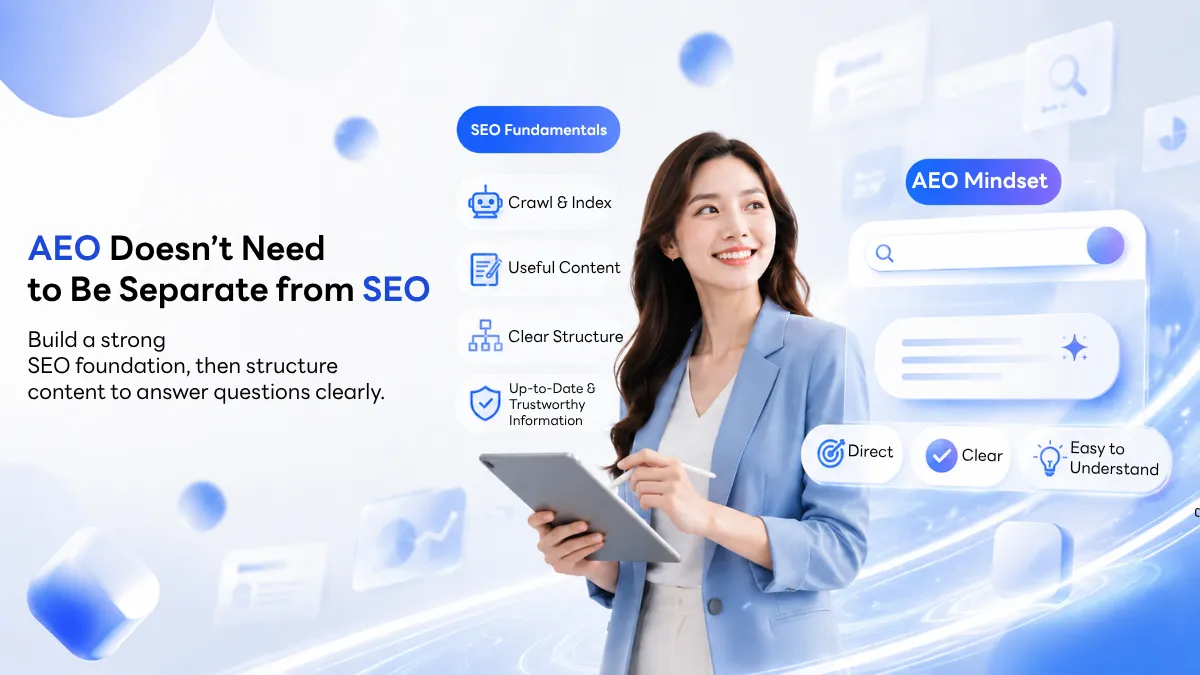
Do You Need to Separate AEO from SEO?
For Google Search, you do not need to build a separate AI-specific website. The core foundations of SEO remain indispensable: ensuring Google can crawl and index pages smoothly, creating high-value content, structuring data clearly, and keeping information accurate and up to date.
AEO should be viewed as a "content structuring mindset" rather than an isolated technical stack. Always ask yourself: when a customer searches with this specific query, does our website deliver an answer that is direct, clear, and easy to digest?
To evaluate how ready your current website is for next-generation search, explore our Checklist for AI Search-Ready Websites 2026.
Conclusion
A business website that competes successfully on Google is not built on repetitive keyword stuffing. It requires multiple elements working in harmony: Site Structure, Search Intent alignment, Content Quality, Technical SEO, Core Web Vitals, Internal Linking, Structured Data, and genuine business credibility.
AEO does not replace SEO; it refines how clearly our website answers customer questions. Ultimately, whether dealing with traditional search engines or AI-assisted search ecosystems, the primary goal remains identical: connecting users with useful, precise answers that fulfill their intent.
If you are planning a new corporate website or have an existing site that fails to show up for your core services on Google, the team at TumWebSME can analyze your website architecture, UX/UI, and SEO foundation to prepare your business for long-term search visibility and sustainable growth. View Web Development Packages | View Portfolio & Reviews | Free Consultation with the TumWebSME Team


 @tumwebsme

