'%20fill='%231C48DD'/%3e%3crect%20width='26.6139'%20height='7.01829'%20rx='3.50914'%20transform='matrix(-0.499958%20-0.866049%20-0.866001%200.500041%2037.7142%2021.771)'%20fill='%23FFCA29'/%3e%3cpath%20d='M13.4697%200C15.4076%20-8.4718e-08%2016.9794%201.57091%2016.9795%203.50879V20.4912C16.9794%2022.4291%2015.4076%2024%2013.4697%2024C11.532%2023.9998%209.96108%2022.4289%209.96094%2020.4912V7.01855H3.50977C1.57167%207.01855%200.00017846%205.44782%200%203.50977C-1.69425e-07%201.57156%201.57156%201.69462e-07%203.50977%200H13.4697Z'%20fill='%231C48DD'/%3e%3crect%20width='7.01887'%20height='7.01809'%20rx='3.50905'%20transform='matrix(-4.37066e-08%20-1%20-1%204.37162e-08%2054.5601%207.01886)'%20fill='%231C48DD'/%3e%3c/svg%3e)


Seeing a website development offer for 3,000–5,000 THB and finding it attractive is completely understandable. For certain businesses that only need a simple, small-scale website without complex features and are fully aware of its limitations, an entry-level price point like this might sufficiently meet their needs.
The problem arises when we evaluate a website based solely on the "initial price" without checking what is actually included such as Responsive Design, back-office CMS, SEO foundation, Hosting, Data Backups, post-launch maintenance, or scalability for future development.
A website that looks economical on day one may not always be the cheapest option in the long run if launching it leads to additional expenses for fixes, platform migrations, or starting over from scratch. This article highlights 5 hidden costs that SME business owners should thoroughly inspect before choosing a web development solution. If you are currently planning your budget, you can learn more in SME Website Development Pricing 2026 to understand what factors influence web development costs.
Are Cheap Websites Really That Bad?
Not necessarily. The term "cheap" does not define the overall quality of a website. A well-designed, properly maintained template website can adequately serve specific business models. At the same time, an expensive website is no guarantee of achieving solid business results either.
What business owners should ask is not merely "How much does this website cost?" but rather "What is included in this price, how long will it last, and can the website scale seamlessly as the business grows?"
True cost-effectiveness lies in balancing your budget, specific business requirements, and the total cost of ownership throughout the website's lifecycle.
5 Hidden Website Costs Business Owners Often Overlook
1. Opportunity Cost from a Poor User Experience
Imagine a customer searching for your services on Google and visiting your site via a mobile device, only to encounter slow loading speeds, difficult navigation, or missing contact buttons. No matter how great your products or services are, these friction points significantly increase the likelihood that visitors will leave the site before reaching out.
Speed is a vital component of user experience. Google relies on Core Web Vitals to measure real-world user experience across loading speed, interactivity, and visual stability.
Therefore, when evaluating a website, do not just check whether the page "opens." Test it thoroughly on mobile devices: check the speed, tap through buttons, and verify how easily customers can access critical information or reach out to you.
2. Costs of Rebuilding or Redesigning as the Business Grows
In the early stages, a website might only need basic company profile pages, service listings, and contact details. However, as the business expands, you may require booking engines, membership portals, multi-language support, API integrations, or advanced back-office systems.
If the original website was built on a rigid structure that cannot support these capabilities, adding new features can become difficult or cost-prohibitive making a complete rebuild the only viable option.
This does not mean every SME must start with a massive Custom Website right away. A better approach is to build what is necessary today while selecting an architecture that keeps the door open for future growth.
If you are still unsure whether to choose a template-based platform or a custom build, explore our guide: Website Building Guide 2026: Should SMEs Choose a Ready-Made Platform or a Custom Website?
3. Post-Launch Maintenance and Troubleshooting Costs
A website is not a finished product that remains functional indefinitely without intervention. Over the long haul, ongoing requirements include Hosting, Domains, Backups, Security patches, system updates, and resolving potential bugs that appear during real-world usage.
Before selecting a provider, clarify these points upfront: Who handles support after delivery? Which channels do you use for reporting issues? Are there ongoing maintenance fees? How are data backups managed?
Knowing these costs beforehand enables businesses to budget accurately instead of solely focusing on the initial build cost. For more details, read Why Website Maintenance & Support is Critical for Business Websites.
4. Future SEO Restructuring Costs
While SEO can always be optimized later, having an improper structural foundation from the start often requires substantial development effort to fix such as Site Structure, URL schema, Heading tags, Internal Linking, Metadata, Sitemaps, load speed, or Structured Data.
Google recommends building websites with clear structures that search engines can easily crawl and index, alongside prioritizing performance, security, and cross-device responsiveness.
Considering SEO architecture during the initial planning phase saves you from tearing down and rebuilding later. Keep in mind that SEO does not guarantee instant top rankings; structural compliance is only the baseline valuable content tailored to your target audience's search intent is equally essential.
To dive deeper into the fundamentals, check out What is SEO? A Comprehensive Guide for Business Owners.
5. Credibility and Brand Trust Costs
A website often serves as the primary touchpoint prospective customers use to evaluate your business, especially when encountering your brand for the first time. The site must clearly communicate who you are, what services you provide, your track record, and how to get in touch.
Outdated information, broken layouts on mobile, dead links, or hard-to-find contact channels erode user trust. Conversely, a website with clear messaging, smooth navigation, and trust-building elements such as portfolios, client reviews, corporate details, and visible contact points effectively removes hesitation before a customer contacts you.
How Should You Compare Website Pricing?
Instead of comparing Company A (5,000 THB) directly against Company B (90,000 THB) and concluding that the cheaper option offers better value, evaluate the actual deliverables side by side:
What to Check | Questions to Ask |
|---|---|
Scope of Work | How many pages are included, and what specific features are provided? |
Design | Is it a generic template, or custom-designed around your brand identity? |
Mobile Responsiveness | Is it fully optimized across mobile and tablet viewports? |
SEO Foundation | Does it include a proper baseline technical SEO structure? |
CMS | Can you update and manage the content independently? |
Hosting & Security | Are Hosting, SSL certification, and automated backups included? |
Ownership | Who holds legal ownership of the Domain, content assets, and source code? |
Maintenance | Is there a dedicated support team after delivery? |
Scalability | How easily can new features or modules be added in the future? |
Evaluating these criteria reveals that two proposals labeled as a "Company Website" often entail drastically different scopes of work which is why web development does not have a single standard price for every business.
6 Warning Signs to Inquire Further Before Hiring a Web Agency
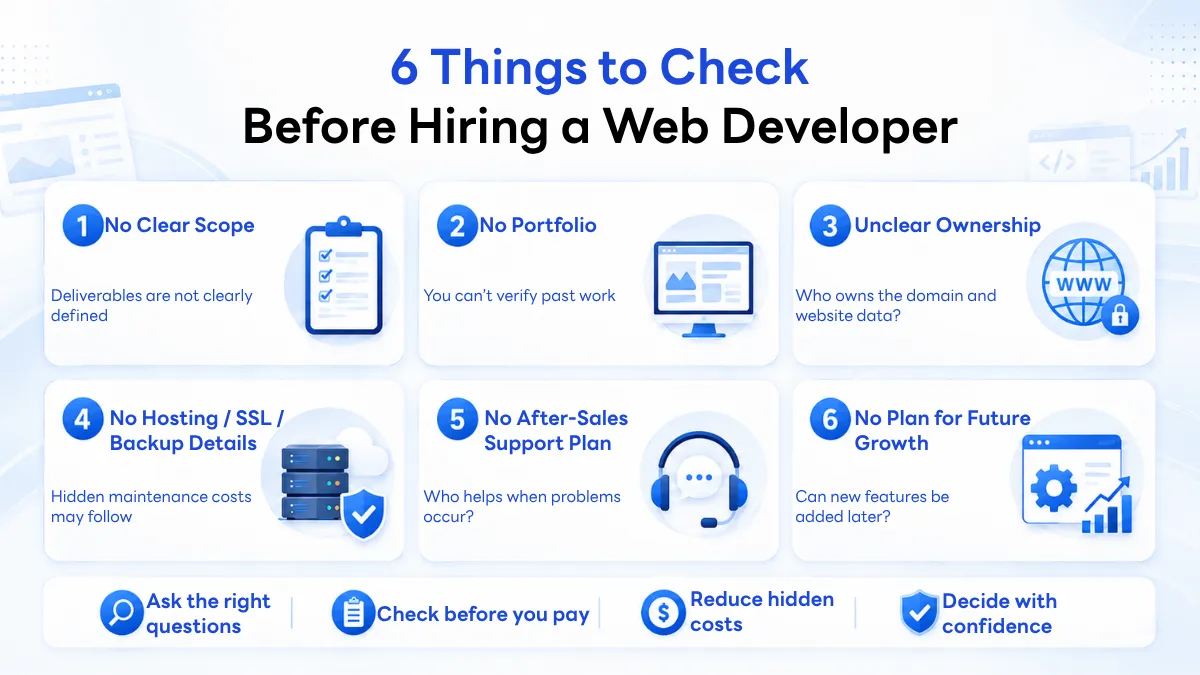
A low price tag is not inherently a red flag. However, if you run into any of the following scenarios, ask for further clarification before committing:
No clear Scope of Work or detailed technical specifications defining what will be delivered
Inability to show a verifiable portfolio or live reference websites
Unspecified ownership regarding the domain name and website data
Lack of details regarding hosting specifications, SSL certificates, or backup protocols
No explanation of post-delivery maintenance and technical support
Inability to explain how future feature additions will be handled
Providers have varying service models, and the goal is not immediate dismissal. Rather, business owners should obtain transparent answers before paying to avoid unexpected expenses down the road.
If you are preparing to hire a web agency, consult our 7 Things to Know Before Building a Website in 2026 before deciding.
Evaluate Value by Business Goals, Not Just the Quote's Total
A restaurant website, a B2B corporate portal, and a real estate directory serve entirely different business objectives; therefore, pricing alone cannot measure their ultimate return.
Before initiating a project, define clearly what you want the website to accomplish: generating leads, driving bookings, establishing brand authority, reducing customer support queries, or ranking for SEO. Then, select a scope and budget aligned with those objectives.
Calculating ROI can start simply by comparing the volume of qualified leads or sales generated by the website against the total cost of ownership across its active lifespan, rather than assuming every website type breaks even on the same timeline.
How Does Building a Website with TumWebSME Differ?
TumWebSME develops bespoke Custom Websites designed and engineered around the distinct needs of each business avoiding rigid, one-size-fits-all pre-made templates. Our dedicated team manages the entire lifecycle, from requirements analysis and UX/UI design to custom development and comprehensive quality testing before launch.
We place strong emphasis on technical SEO architecture, high-performance page speed, fluid mobile responsiveness, and clean codebase scalability for future expansion, backed by dedicated Care plans for post-launch maintenance.
Most importantly, not every business needs to start with an overly complex, feature-heavy website on day one. We begin by identifying your core business objectives and essential requirements before scoping the project.
Conclusion
An affordable website can be a suitable solution for certain businesses, provided the scope matches immediate needs and limitations are fully understood from day one. The key pitfall is deciding solely on price without factoring in long-term expenses including technical maintenance, SEO retrofitting, architectural scalability, and the operational time lost if the platform fails to meet your business needs.
A cost-effective website does not have to be the most expensive one; it should be the one best tailored to your business goals and built on a foundation ready to scale alongside your future vision.
If you are currently comparing agency quotes or evaluating whether to revamp or rebuild your existing website, TumWebSME can help analyze your requirements and define a tailored scope. View TumWebSME Packages & Services | Explore Our Portfolio & Reviews | Get a Free Consultation with TumWebSME
Book a free, no-obligation consultation to clearly understand what your business website needs before you invest, ensuring every baht spent delivers measurable returns.


'/%3e%3cpath%20d='M31.3333%2016.667H31.3466M17.3333%2010.667H30.6666C34.3485%2010.667%2037.3333%2013.6518%2037.3333%2017.3337V30.667C37.3333%2034.3489%2034.3485%2037.3337%2030.6666%2037.3337H17.3333C13.6514%2037.3337%2010.6666%2034.3489%2010.6666%2030.667V17.3337C10.6666%2013.6518%2013.6514%2010.667%2017.3333%2010.667ZM29.3332%2023.1604C29.4978%2024.2701%2029.3082%2025.4034%2028.7916%2026.3991C28.2749%2027.3948%2027.4574%2028.2023%2026.4554%2028.7066C25.4534%2029.211%2024.3178%2029.3865%2023.2103%2029.2083C22.1027%2029.0301%2021.0796%2028.5072%2020.2863%2027.714C19.4931%2026.9207%2018.9702%2025.8976%2018.792%2024.79C18.6138%2023.6825%2018.7893%2022.5469%2019.2937%2021.5449C19.798%2020.5429%2020.6055%2019.7254%2021.6012%2019.2087C22.5969%2018.6921%2023.7302%2018.5025%2024.8399%2018.6671C25.9718%2018.8349%2027.0197%2019.3624%2027.8288%2020.1715C28.6379%2020.9806%2029.1654%2022.0285%2029.3332%2023.1604Z'%20stroke='white'%20stroke-width='2.66667'%20stroke-linecap='round'%20stroke-linejoin='round'/%3e%3cdefs%3e%3clinearGradient%20id='paint0_linear_1738_1796'%20x1='24'%20y1='7.52509e-07'%20x2='22.5'%20y2='50.5'%20gradientUnits='userSpaceOnUse'%3e%3cstop%20stop-color='%237C1CC7'/%3e%3cstop%20offset='0.5'%20stop-color='%23EC1E80'/%3e%3cstop%20offset='1'%20stop-color='%23FADF02'/%3e%3c/linearGradient%3e%3c/defs%3e%3c/svg%3e)
'%3e%3cpath%20d='M0%2024C0%2010.7452%2010.7452%200%2024%200C37.2548%200%2048%2010.7452%2048%2024C48%2037.2548%2037.2548%2048%2024%2048C10.7452%2048%200%2037.2548%200%2024Z'%20fill='white'/%3e%3cpath%20d='M24%200C10.7456%200%200%2010.7456%200%2024C0%2037.2544%2010.7456%2048%2024%2048C37.2544%2048%2048%2037.2544%2048%2024C48%2010.7456%2037.2544%200%2024%200ZM38.8791%2020.9662C35.8378%2020.9662%2033.0187%2019.9931%2030.7172%2018.3412V30.2644C30.7172%2036.2184%2025.8731%2041.0625%2019.9191%2041.0625C17.6175%2041.0625%2015.4847%2040.3369%2013.7306%2039.1059C10.9453%2037.1503%209.12094%2033.9178%209.12094%2030.2644C9.12094%2024.3094%2013.965%2019.4653%2019.9191%2019.4653C20.4131%2019.4653%2020.8978%2019.5066%2021.3741%2019.5712V25.56C20.9137%2025.4156%2020.4263%2025.3322%2019.9191%2025.3322C17.1994%2025.3322%2014.9869%2027.5447%2014.9869%2030.2644C14.9869%2032.1581%2016.0613%2033.8034%2017.6316%2034.6294C18.3159%2034.9894%2019.0931%2035.1956%2019.9191%2035.1956C22.5759%2035.1956%2024.7425%2033.0825%2024.8409%2030.45L24.8503%206.9375H30.7172C30.7172%207.44562%2030.7669%207.94344%2030.8559%208.42625C31.2694%2010.6613%2032.5969%2012.5794%2034.4344%2013.7775C35.715%2014.6128%2037.2412%2015.0994%2038.8791%2015.0994V20.9662Z'%20fill='black'/%3e%3c/g%3e%3cdefs%3e%3cclipPath%20id='clip0_1738_1802'%3e%3cpath%20d='M0%2024C0%2010.7452%2010.7452%200%2024%200C37.2548%200%2048%2010.7452%2048%2024C48%2037.2548%2037.2548%2048%2024%2048C10.7452%2048%200%2037.2548%200%2024Z'%20fill='white'/%3e%3c/clipPath%3e%3c/defs%3e%3c/svg%3e)