'%20fill='%231C48DD'/%3e%3crect%20width='26.6139'%20height='7.01829'%20rx='3.50914'%20transform='matrix(-0.499958%20-0.866049%20-0.866001%200.500041%2037.7142%2021.771)'%20fill='%23FFCA29'/%3e%3cpath%20d='M13.4697%200C15.4076%20-8.4718e-08%2016.9794%201.57091%2016.9795%203.50879V20.4912C16.9794%2022.4291%2015.4076%2024%2013.4697%2024C11.532%2023.9998%209.96108%2022.4289%209.96094%2020.4912V7.01855H3.50977C1.57167%207.01855%200.00017846%205.44782%200%203.50977C-1.69425e-07%201.57156%201.57156%201.69462e-07%203.50977%200H13.4697Z'%20fill='%231C48DD'/%3e%3crect%20width='7.01887'%20height='7.01809'%20rx='3.50905'%20transform='matrix(-4.37066e-08%20-1%20-1%204.37162e-08%2054.5601%207.01886)'%20fill='%231C48DD'/%3e%3c/svg%3e)


Tourists planning a trip to Phuket can simply open Google, search for “Phuket island tour,” “James Bond Island tour,” or “Phuket snorkeling tour,” and compare multiple tour operators within minutes. The critical question is no longer just whether your business has a website, but whether it provides sufficient, easily discoverable information to help prospective customers make a booking decision right when they are searching.
Today, a Phuket tour website should not function merely as an online brochure or a company profile page. Instead, it should guide visitors through the entire journey from discovering information, exploring tour itineraries, comparing prices, and checking trip details, all the way to submitting a booking or completing a payment with minimal friction. Furthermore, to help new customers find your site on Google, understanding What is SEO? along with a site architecture that search engines can easily crawl and index remains essential.
Common Challenges Tour Operators Face When Websites Do Not Support Sales
Many tour operators start by taking bookings via Facebook, LINE, WhatsApp, or direct messaging. While effective for personal conversations and custom recommendations, handling multiple inquiries at once can overwhelm staff with repetitive questions: Is there availability tomorrow? What is the child rate? Does the package include hotel transfer or meals? Can we pay by credit card?
If this information is missing from the website, customers still have to wait for manual replies. For international travelers, this friction is magnified by time zone differences or the fact that they are comparing multiple operators simultaneously. A tour website should answer these foundational questions and empower travelers to complete the booking process independently.
Another vital factor is website performance. Travel websites rely heavily on high-resolution images and videos; without proper file optimization and solid web architecture, mobile user experience suffers significantly. Google utilizes Core Web Vitals as part of its page experience signals, evaluating main content loading speed, interactivity responsiveness, and visual layout stability. However, Core Web Vitals should not be treated as a score that automatically guarantees top rankings upon passing, but rather as an essential foundation for delivering a seamless experience for both users and search engines.
Essential Features for a Phuket Tour Website
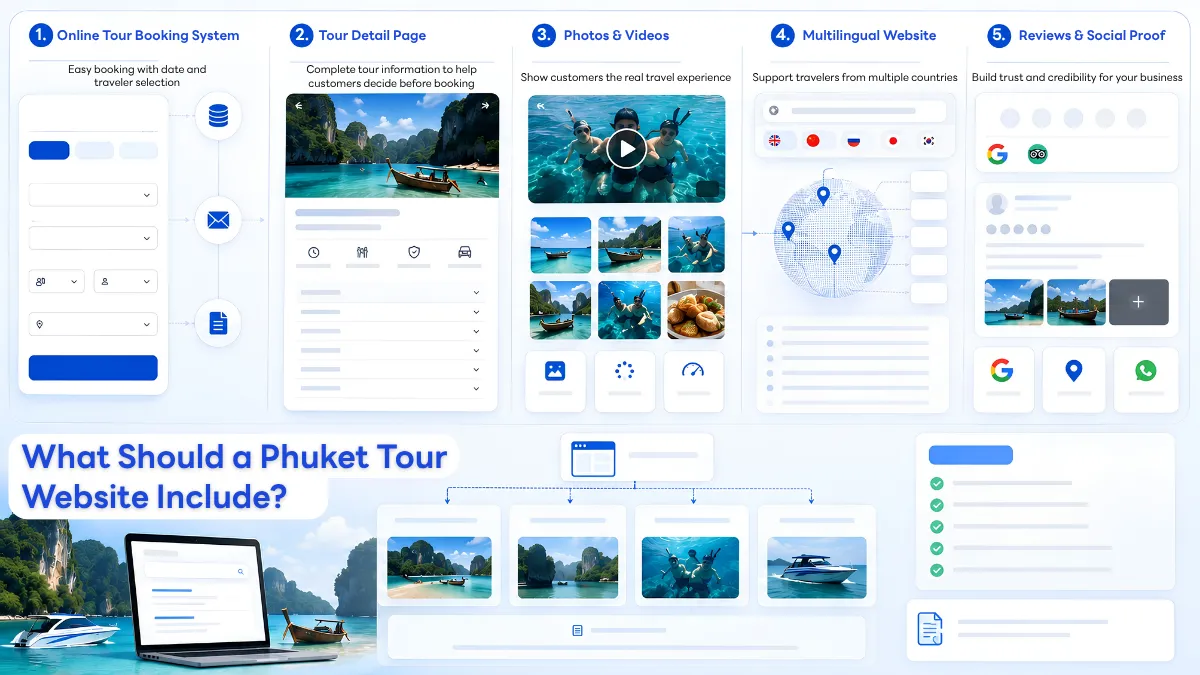
Online Tour Booking System
For businesses offering diverse tour packages, the website should enable customers to customize key options independently including selecting the tour program, travel dates, number of guests, adult and child pricing, pickup/drop-off locations, and add-on services before proceeding to checkout.
If real-time seat availability is required, the website must integrate with a centralized database or booking engine to prevent data discrepancies across sales channels. Once a transaction is completed, the system can automatically send booking confirmations or travel itineraries tailored to your operational workflow.
Tour Detail Pages That Answer Questions in Advance
For tour operators, the Tour Detail Page is one of the most critical assets, as it directly drives the customer's decision to book. The page should go beyond just displaying a tour title, a gallery, and a price tag. It must clearly outline essential details such as highlights, full itinerary, duration, departure points, pickup zones, inclusions/exclusions, child policies, cancellation terms, preparation checklists, and pre-departure FAQs.
The more comprehensively a tour page answers essential questions, the less likely visitors will leave to ask basic inquiries via chat. This approach also aligns well with modern search and AI-driven discovery, as structured and direct content helps both readers and search engines digest information effortlessly. You can explore more on this in How to Optimize Websites for AI Search.
Authentic Photos and Videos That Showcase Real Experiences
Selling tours is fundamentally different from selling physical goods that customers can inspect before buying. What travelers are purchasing is a future experience. High-quality visuals of the sea, boats, snorkeling spots, meals, transfer vehicles, trip atmospheres, and actual activities convey far more value than generic promotional text.
However, loading unoptimized high-resolution media can drastically slow down page speed. Websites need a proper technical setup from dimension selection and image compression to modern formats, lazy loading, and optimized video embeds to maintain the right balance between stunning visuals and fast performance.
Multilingual Website Architecture Built Right from the Start
Phuket's tourism market serves travelers worldwide, spanning languages such as English, Chinese, Russian, Japanese, and Korean.
A proper multilingual website requires more than just adding a language switcher widget. For effective multilingual SEO, each language version must have dedicated URL structures (e.g., /en/, /zh/, or /ru/) along with correct hreflang implementation to help Google understand regional and language relationships across pages.
Beyond technical SEO, translation quality is paramount particularly regarding pricing, cancellation policies, safety information, and critical booking terms since inaccurate translations can lead to customer misunderstandings and operational issues.
Customer Reviews and Social Proof for Business Verification
Before booking activities abroad, travelers seek reassurance that an operator is legitimate, safe, and established. Websites should feature verifiable proof, including authentic customer reviews, real trip photos, clear contact details, physical office locations, business registration details, and direct links to Google Business Profile or relevant review platforms.
When embedding reviews from platforms like Google or TripAdvisor, maintain transparency by citing the original source rather than fabricating ratings. Credibility comes from verifiable authenticity, not inflated review scores.
Tour SEO Beyond Just Stuffing "Phuket Tour"
If your company offers multiple excursions such as Phi Phi Island tours, Phang Nga Bay/James Bond Island trips, scuba diving, private boat charters, or Phuket city tours cramming every service onto a single page to rank for all keywords will confuse both prospective customers and search engines regarding primary search intent.
Instead, structure dedicated pages tailored to specific services and search queries (e.g., a main Phuket Tours hub page linking out to dedicated pages for Phi Phi Island Tour, James Bond Island Tour, Phuket Snorkeling Tour, and Private Phuket Tour). Complement these landing pages with informative blog articles addressing common pre-booking questions, such as the best months to visit Phi Phi Island, duration of James Bond Island tours, or differences between private and join-in trips.
This targeted architecture clarifies page intent and establishes natural internal linking. If you are currently structuring a new site, refer to 7 Things to Know Before Building a Website in 2026 for further insights.
The Role of Local SEO for Phuket Tour Operators
For operators with physical offices, counters, or customer pickup points, Google Business Profile is a primary channel to keep accurate and up-to-date including business name, address, phone number, operating hours, website URL, business category, photos, and customer reviews.
Google determines local search ranking based on relevance, distance, and business prominence. Local SEO is therefore not about keyword-stuffing "Phuket," but about maintaining consistent, verifiable business information across services and target operational zones.
How Schema Markup Supports Tour Websites
Schema Markup (Structured Data) is a standardized code format that helps search engines interpret page components accurately.
Tour operator websites can implement structured data matching on-page content, such as Organization, LocalBusiness, Breadcrumb, or Article markup. The fundamental rule is that schema code must accurately reflect content visible to real users.
Structured data does not guarantee immediate ranking jumps or automatic rich snippet displays on Google; it should be viewed as a technical framework for organizing page data clearly rather than a shortcut to top rankings.
The Impact of AI Search on Tour Websites
Search behavior has evolved beyond short keyword phrases. Travelers frequently ask complex, situational questions, such as “Which Phuket island tour is suitable for family with kids?” or “What should I prepare before a Phi Phi Island tour?”
If a website only provides tour names and price tags without addressing these practical scenarios, it fails to meet modern searcher intent. Answer Engine Optimization (AEO) pairs with traditional SEO to deliver direct, structured, verifiable, and easy-to-digest answers.
AEO does not require building an entirely separate website for AI; foundational elements like crawling, indexing, clean site structure, internal linking, and high-quality content remain just as critical. To evaluate your site readiness, review the AI Search Website Checklist 2026.
Why Tour Websites Must Begin with Business Requirements
Deciding between a template or a custom-coded website should not revolve around which option is inherently better, but rather around your actual business workflow and functional requirements.
If you only need a straightforward brochure site to showcase itineraries and collect inquiries, a simpler setup may suffice. However, if your operations involve an integrated booking engine, payment gateways, live seat availability, coupon systems, multi-currency support, CRM integration, APIs, or channel connections with OTAs, detailed architectural planning before development is essential.
TumWebSME adopts a custom-code development approach to engineer site architectures and systems specifically around each business’s unique requirements, eliminating the need to compromise internal workflows to fit template limitations.
A high-performing Phuket tour website is not measured by visual animations or decorative design elements, but by whether prospective travelers can effortlessly find the information they need, understand trip itineraries, verify company credibility, and transition smoothly from discovery to a confirmed booking.
When online booking systems, detailed tour itineraries, multilingual capabilities, mobile responsiveness, and SEO fundamentals work together seamlessly, a website transforms from a passive company profile into an automated channel that streamlines operations and drives direct bookings.
If you are planning to build or upgrade a tour or travel website in Phuket, TumWebSME provides end-to-end expertise across business requirement analysis, UX/UI design, custom development, backend systems, and foundational SEO. Explore TumWebSME Packages & Services | View Portfolio & Case Studies. Contact the TumWebSME team for a consultation via LINE @tumwebsme or call 088-983-9386.


 @tumwebsme

