'%20fill='%231C48DD'/%3e%3crect%20width='26.6139'%20height='7.01829'%20rx='3.50914'%20transform='matrix(-0.499958%20-0.866049%20-0.866001%200.500041%2037.7142%2021.771)'%20fill='%23FFCA29'/%3e%3cpath%20d='M13.4697%200C15.4076%20-8.4718e-08%2016.9794%201.57091%2016.9795%203.50879V20.4912C16.9794%2022.4291%2015.4076%2024%2013.4697%2024C11.532%2023.9998%209.96108%2022.4289%209.96094%2020.4912V7.01855H3.50977C1.57167%207.01855%200.00017846%205.44782%200%203.50977C-1.69425e-07%201.57156%201.57156%201.69462e-07%203.50977%200H13.4697Z'%20fill='%231C48DD'/%3e%3crect%20width='7.01887'%20height='7.01809'%20rx='3.50905'%20transform='matrix(-4.37066e-08%20-1%20-1%204.37162e-08%2054.5601%207.01886)'%20fill='%231C48DD'/%3e%3c/svg%3e)


This article explores modern SEO strategies designed to align with AI search systems, ensuring your business website maintains its visibility on Google’s first page sustainably.
Adapting to Customer Behavior: How AI is Transforming Google Search
The first thing business owners need to know is that search behavior has completely changed. Today, users tend to search using longer, conversational phrases and specific questions. More importantly, this has led to the rise of "Zero-Click Searches"—a phenomenon where users get answers instantly from AI-generated summaries on Google, causing over 58% of searches to end without a single click to any website.
Content Strategy: Writing for Algorithms and Real Audiences
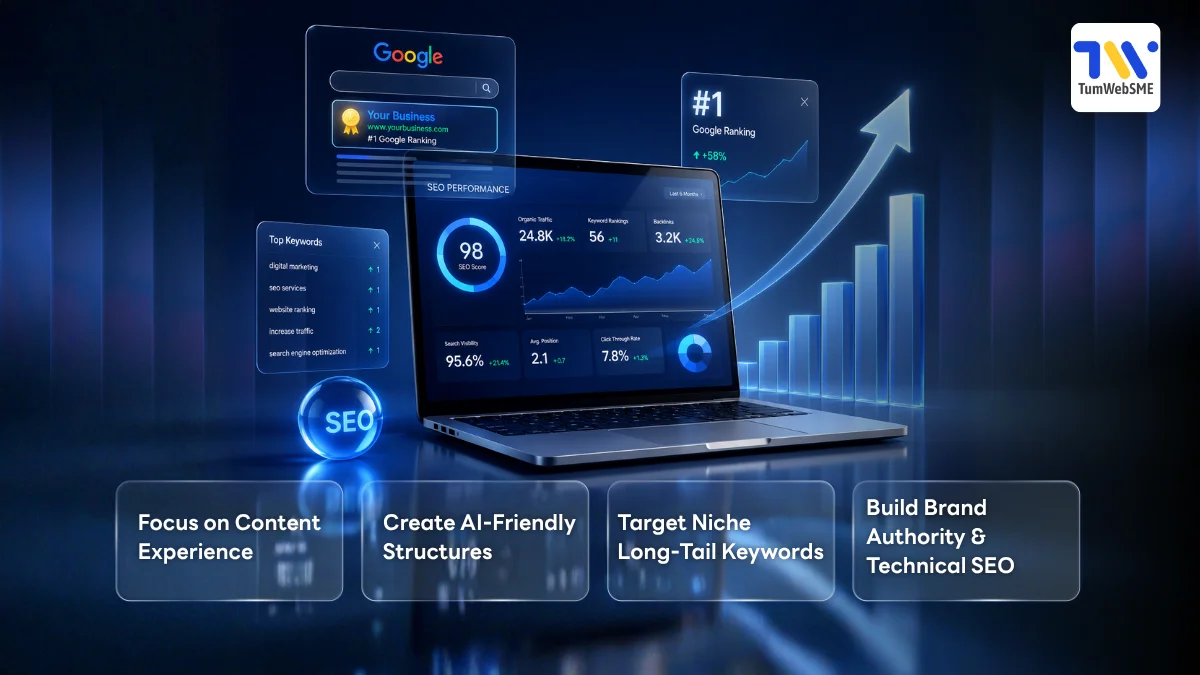
The key is tailoring your content to how search systems filter information today. Here are the three main areas you should focus on:
1. Focus on Content Experience
Leverage E-E-A-T (Experience): Highlight first-hand experience by incorporating case studies, client reviews, or unique professional perspectives that AI cannot replicate.
Avoid 100% AI-Generated Content: Refrain from publishing raw, unedited AI content to prevent shallow and repetitive articles, ensuring your brand maintains high credibility.
2. Create AI-Friendly Structures
Apply Direct Answers: Summarize key answers clearly and concisely within the very first paragraph to maximize your chances of capturing AI Snippets.
Keep It Scannable: Organize content using proper heading hierarchies (H2, H3), bullet points, comparative tables, and a dedicated FAQ section to make data easily extractable.
3. Target Niche Long-Tail Keywords
Shift to Conversational Phrases: Move away from short keywords and focus on natural, conversational long-tail keywords (4+ words) that match modern search behaviors.
Aim for Higher Conversions: Target specific search queries that drive higher conversion rates, as these users possess clearer intent and are closer to making a purchase decision.
4. Build Brand Authority & Technical SEO
Branding: Establish author profiles (Personal Brand SEO), accumulate social proof, and utilize a Pillar-Cluster content structure to position your brand as a trusted entity.
Technical SEO: Embed relevant videos (Video SEO), use original imagery with descriptive Alt Text (Visual Search), optimize page speed to load within 3 seconds, and implement Structured Data (Schema Markup) to act as a translator for search engines.
Authority & Branding: Putting Identity over Tactics
Modern search systems look beyond on-page data; they evaluate the credibility and real-world presence of both the author and the brand.
Optimize Personal Brand SEO: When authors have a clear professional history or share insights on platforms like LinkedIn, it helps systems verify that the content originates from a genuine expert.
Accumulate Social Proof: Reviews on Google Maps and brand mentions across reputable online media act as crucial trust signals for your business.
Build Topical Authority: Avoid publishing random topics. Use a Pillar-Cluster structure—create a main pillar page that summarizes a broad topic, then link it to in-depth cluster articles to show comprehensive expertise.
Entity-Based SEO: Search systems treat brands as unique entities. Getting your brand mentioned in authoritative sources, interviews, or press releases helps AI recommend your business more accurately.
To stay updated with the latest tech trends and view our latest projects, follow our team at TumWebSME or connect with us on our TumWebSME Facebook page.
Technical SEO & Media Formats
Beyond text, how you present your content and manage your backend technicalities heavily impacts your visibility.
Leverage Video SEO: Videos from YouTube or TikTok frequently appear in search results. Embedding relevant videos into your articles effectively increases user Dwell Time.
Optimize for Visual Search: Use original, high-quality images and add descriptive Alt Text to ensure your media is discoverable via tools like Google Lens.
Mobile-First & Speed: Your website must be fully optimized for mobile devices and load within 3 seconds to deliver the best user experience.
Implement Structured Data (Schema): Adding proper Schema code (such as Organization, FAQ, and Article) acts as a translator, helping AI instantly understand what your content is about and who wrote it.
While backend technicalities can be complex, the TumWebSME team is ready to handle every step for you—from data structuring to speed optimization for AI compatibility. Learn more about our services at High-Quality Custom Web Development by TumWebSME.
New Metrics for Success
As search behaviors evolve, website traffic should no longer be your sole metric. Shift your focus toward these modern key performance indicators:
AI Citations: Tracking how often your brand or content is cited by AI systems when answering user queries.
Brand Mentions: Monitoring how frequently your business is discussed across online communities and platforms.
Engagement (Dwell Time): Measuring the time users spend reading your articles to evaluate content quality.
Conversions: Prioritizing quality traffic that leads to actual sales or inquiries over raw pageviews.
Share of Voice: Evaluating the rate at which AI selects your brand’s answers compared to competitors in your industry.
FAQ: Essential Insights on Modern SEO
How is SEO different today compared to the past?
The focus has shifted from simply ranking in the traditional top 10 blue links to optimizing for Google AI Overview—the summarized answer box at the top of search results. The goal is no longer just earning clicks (Traffic), but becoming the most trusted source that the system chooses to recommend.
How can a website get featured in Google AI Overview?
Focus on creating high-quality content based on E-E-A-T principles, particularly emphasizing Experience—sharing real-world perspectives that AI cannot replicate. Additionally, structure your articles with quick summaries at the beginning of sections, and use bullet points or tables to make the data easily digestible for algorithms.
What is a Zero-Click Search, and how should businesses respond?
It occurs when a user finds the answer they need directly on the Google search results page without clicking through to any website. Businesses should respond by building deep Topical Authority so that AI systems use and cite your brand name as the source, while shifting internal success metrics toward conversion quality rather than overall traffic volume.
What kind of keywords should I target?
Focus on Long-Tail Keywords that reflect natural, conversational speech (typically 4 or more words), such as "SEO strategies for service businesses in 2026." Users now search with specific questions, and these targeted phrases yield significantly higher conversion rates than short, generic terms.
Will using AI to write articles get my website banned?
Google does not penalize the use of AI tools, provided the content remains high-quality. However, entirely automated content often lacks depth and first-hand experience, which damages your site's credibility over time. The best approach is a Human-in-the-Loop strategy: use AI to draft the structure, then have an expert add real insights and human perspectives.
Conclusion: Adapting for Sustainable Growth
SEO today is not about manipulating algorithms; it is about building a reputable business ecosystem combining authentic authority (Reputation), valuable content (Content), intuitive user experience (UX), and the smart application of technology.
Our expertise is proven by real results across numerous client projects. You can review our work standards and design concepts on our Portfolio page at TumWebSME.
When your website becomes an authentic, deeply knowledgeable resource with a verifiable presence, it will remain the answer Google chooses to present—no matter how advanced the AI becomes.
By the TumWebSME Team – Empowering SMEs to lead on the modern search landscape.


 @tumwebsme

