'%20fill='%231C48DD'/%3e%3crect%20width='26.6139'%20height='7.01829'%20rx='3.50914'%20transform='matrix(-0.499958%20-0.866049%20-0.866001%200.500041%2037.7142%2021.771)'%20fill='%23FFCA29'/%3e%3cpath%20d='M13.4697%200C15.4076%20-8.4718e-08%2016.9794%201.57091%2016.9795%203.50879V20.4912C16.9794%2022.4291%2015.4076%2024%2013.4697%2024C11.532%2023.9998%209.96108%2022.4289%209.96094%2020.4912V7.01855H3.50977C1.57167%207.01855%200.00017846%205.44782%200%203.50977C-1.69425e-07%201.57156%201.57156%201.69462e-07%203.50977%200H13.4697Z'%20fill='%231C48DD'/%3e%3crect%20width='7.01887'%20height='7.01809'%20rx='3.50905'%20transform='matrix(-4.37066e-08%20-1%20-1%204.37162e-08%2054.5601%207.01886)'%20fill='%231C48DD'/%3e%3c/svg%3e)


Many people might wonder, "Why is having just a Facebook Page, as I’ve always done, starting to become a problem?"
In 2026, the online business environment has entered a Highly Complex Ecosystem. Previously, social media served as a "magic tool" that helped us reach customers easily and quickly.
However, for today's SME, choosing a Facebook Page as your "sole" primary foundation for doing business is no longer just a competitive limitation; it is leading your business into Structural Risk. This is a structural risk that will gradually undermine your brand's potential and growth opportunities in the long term, perhaps without you even realizing it.
In short: In 2026, having only a Facebook Page isn't just a risk of "falling sales," but it is the risk that your "business foundation" could collapse at any time.
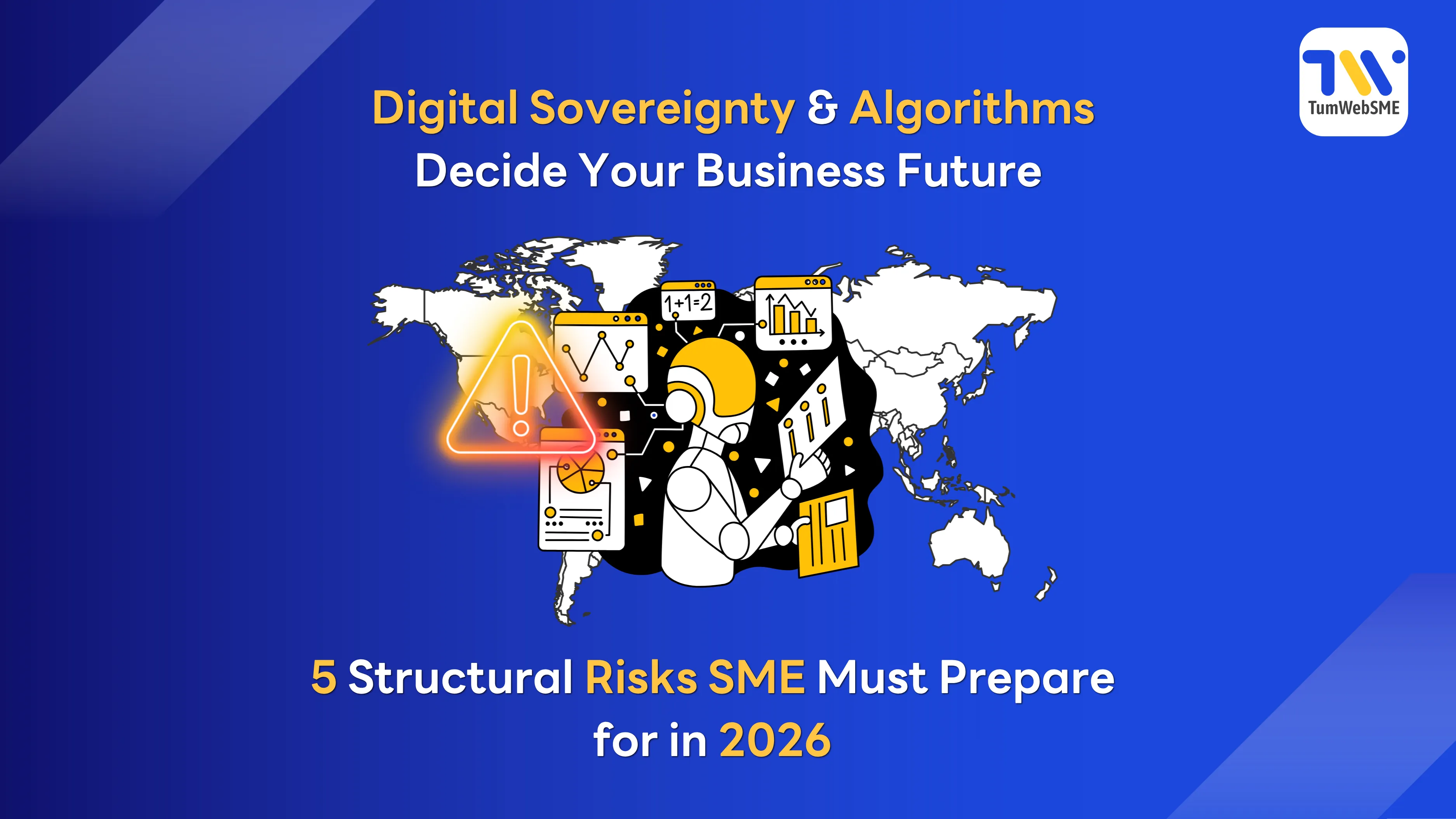
5 Weaknesses SMEs Must Watch Out For: When Having Only a Page Becomes a Time Bomb
If your business is still standing on the single leg of Facebook, here are 5 leaks that TumWebSME wants you to plug before it’s too late:
1. "A House on Rented Land" where the owner can evict us at any time
Doing business solely on a page is like spending a fortune building a luxury house on rented land. No matter how well we maintain the house, if the platform owner decides to change the rules or "reclaim the land" (shadow-banning the page/banning the account), they can do so instantly without asking us. Not having a "home of our own" like a website leaves our business lacking long-term stability.
2. "Ever-Inflating Advertising Costs" because we don't own the channel
In 2026, platforms focus on keeping people engaged with entertaining content, not on helping us sell products. The consequence is that even if you have hundreds of thousands of followers, if you don't "pay the toll" (run ads), they hardly let anyone see your posts. Your customer acquisition costs will keep rising until your net profit is squeezed smaller and smaller.
3. "A Fragile Single Lifeline": If the page vanishes, the business is instantly paralyzed
In the business world, entrusting your life to a single channel is the ultimate risk. Imagine if one day an AI error results in your page being abruptly shut down, or if the system crashes—your business stops immediately. Not having a backup channel that "we control 100%" is allowing your business to live on a risk that could collapse at any second.
4. "Seeing Only Likes, But Never Truly Knowing Your Customers"
Customer data is a goldmine. However, Facebook acts like a "high wall" that only lets us see the surface (likes/comments) but doesn't let us own the actual data (phone numbers/emails/deep buying behaviors). This causes us to lose the opportunity to use data to nurture old customers and encourage repeat purchases—what is known as professional CRM.
5. "Our Brand Looks Just Like Everyone Else" until customers can't remember us
Have you noticed that every page looks exactly the same? This limitation makes your brand look "ordinary" and makes it very difficult to find a point of differentiation. You can hardly design a "Customer Journey" that is "Wow" or unique. Selling on a feed full of distractions unfortunately diminishes the value and credibility of your brand.
Guidelines for Creating "Digital Assets" for Sustainability
Now that you recognize the leaks, let’s look at how to plug them by turning your business into a true "Asset Owner."
1. Create Your Own "Command Base" (Owned Media)
The core essential is having your own Website or Web Application. This is comparable to having land and a title deed in your own name; no one can order it closed or change the rules at will. A website serves as the Hub that gathers everything about your brand in one place with maximum stability.
2. Transform Customer Data into a "Permanent Treasure" (First-party Data)
Stop relying solely on likes and start collecting a Real Database, such as emails, phone numbers, or membership records, through your own CRM system. This data is an "Asset" of immense value because you can contact customers directly at any time without needing to beg the algorithm or pay extra for ads.
3. Build a "Protective Shield" through Multiple Channels (Multi-channel Resilience)
Don’t put all your eggs in one basket. Spread your presence across Google (SEO), LINE OA, and Email Marketing to give your business a strong immune system. If one channel encounters a problem, you still have other channels that can move forward immediately.
4. Let Facebook Act as the "Front Door" (Facebook as a Gateway)
Change Facebook’s role from being the "Main Storefront" to being the "Customer Greeter" instead. Use Facebook’s strength as a Lead Generator to find people, and then transition them into the system you control 100% to close the sale and provide long-term care.
What is a Digital Asset? > In short, it is "Property in the online world" that you actually hold the legal title to. It can generate income and increase the value of your business in the long term, no different from a house or land in the physical world.
Q&A: Strategic Deep-Dive into 2026 Digital Risks
Q: If my page still has high engagement, why do I need a website?
A: High visibility on someone else's platform is "borrowed success." In 2026, algorithms change daily. A website serves to convert temporary views into First-party Data that you can use for marketing immediately, even if social media platforms shut down.
Q: Is a website harder and more expensive to maintain than Facebook?
A: A website requires an initial investment, but in the long run, it significantly reduces marketing costs through SEO accumulation. SEO is an asset that appreciates in value over time, unlike social media posts which have a very short lifespan.
Q: Can I just use Linktree or a Landing Page instead?
A: Those tools help to an extent, but they do not fully solve the Data Ownership issue. A complete website allows you to analyze customer behavior more deeply and builds a much higher level of credibility in a highly competitive market.
Strategic Conclusion: From Tenant to Digital Asset Owner
A Facebook Page in 2026 remains useful as a tool for awareness (Top of Funnel), but it is not a sturdy enough structure for sustainable growth. The solution is to create Owned Media digital assets that you hold full title to. A "Website" is not just an online business card; it is a private asset that protects your data, creates limitless brand experiences, and is an infrastructure that no one can take away from you.
Ready to build a secure future? TumWebSME is ready to be your partner in transcending platform limits toward owning true digital assets. Contact us today to lay the foundation for your sustainable website.
Follow TumWebSME
Stay updated and connect with us through our social channels:
Facebook: TumWebSME รับทำเว็บไซต์ธุรกิจ
Instagram: @tumwebsme
TikTok: @tumwebsme
YouTube: TumWebSME
Contact Us
For inquiries and service information, feel free to reach out:
Phone: 088-983-9386 (Khun Ploy)
Phone: 099-856-3198 (Khun Saennan)


 @tumwebsme

